Contributor Introduction
The main Introduction page gave a brief description of the Readers/Writers, Backends, and DSI Core. This page will provide a more detailed explanation of them, with the following pages delving into how contributors can create their own compatible with DSI.
Similar to the Python User API which uses dsi.py, contributors can view core.py and its documentation, Core, to use the most-flexible version of DSI.
DSI Readers/Writers Classes
Readers/Writers transform an arbitrary data source into a format that is compatible with the DSI core. The parsed and queryable attributes of the data are called metadata – data about the data. Metadata share the same security profile as the source data.
A simple data reader might parse an application’s output file and place it into a core-compatible data structure such as Python built-ins and members of the popular Python collection module.
A simple data writer might execute an application to supplement existing data and queryable metadata, e.g., adding locations of outputs data or plots after running an analysis workflow.
Readers/Writers are defined by a base abstract class, and support child abstract classes which inherit the properties of their ancestors.
A subset of DSI’s Readers and Writers are:
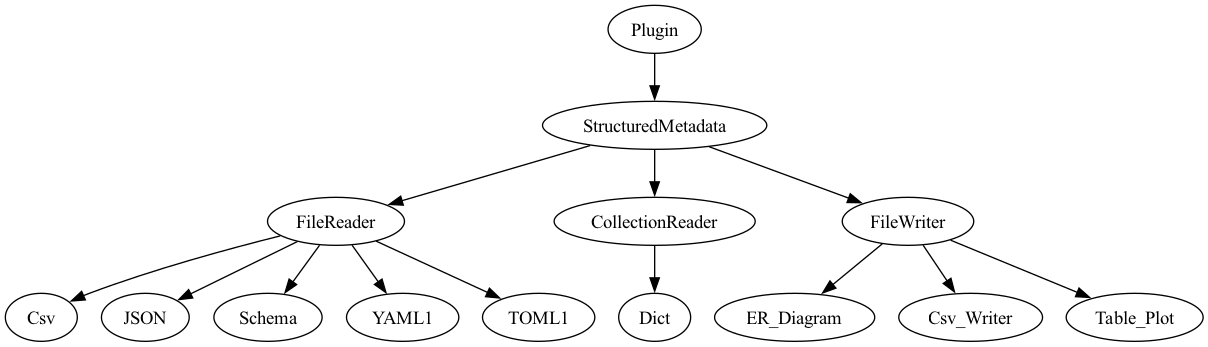
Figure depicting the current DSI Reader/Writer class hierarchy.
Backend Abstract Classes
Backends are an interface between the core and a storage medium designed to support a user-needed functionality. Given the user metadata captured by a DSI frontend, a typical functionality needed by DSI users is to query that metadata. Because the files associated with the queryable metadata may be spread across filesystems and security domains, a supporting backend is required to assemble query results and present them to the DSI core for transformation and return.
DSI currently has two categories of backends:
- Filesystem Backends - Create a permanent database file in the user’s local directory:
SQLite: Python based SQL database and backend; the default DSI API backend. Supports POSIX-enforced file permissions.
DuckDB: In-process SQL database designed for fast queries on large data files. Supports POSIX-enforced file permissions.
GUFI: the Grand Unified File Index system ; developed at LANL. GUFI is a fast, secure metadata search across a filesystem accessible to both privileged and unprivileged users.
- Webserver Backends - Create a connection to a remote data platform for users to retrieve data in-memory:
NDP (Read-only): Connection to data on the National Data Platform
Oceans11 (Read-only): Connection to data on DSI’s open data server:
OSTI (Read-only): Connection to data hosted by the Department of Energy’s Office of Scientific and Technical Information
DSI Core
DSI basic functionality is contained within the middleware known as the core. The DSI core is focused on delivering user-queries on unified metadata which can be distributed across many files and security domains. DSI currently supports Linux, and is tested on RedHat- and Debian-based distributions. The DSI core is a home for DSI Readers/Writers and an interface for DSI Backends.
DSI Sync
DSI data movement functionality is contained within the Sync class.
This middleware enables users to index and copy/move metadata + data to a remote location, or to retrieve the metadata + data from several remote locations.
The currently supported copy/move tools are:
Unix copy: effectively a “cp” command on a filesystem
SCP: Secure Copy Protocol - tool that securely transfers data between a local machine and a remote server
RSync: Remote Sync - more powerful tool than SCP that efficiently transfer data between a local machine and a remote server
conduit: copy tool used by a certain HPC to move data between a staging area and a permanent store
pfcp: copy tool used by a certain HPC to move data between a staging area and a permanent store