
block-adaptive, performance portable multi-material radiation hydrodynamics
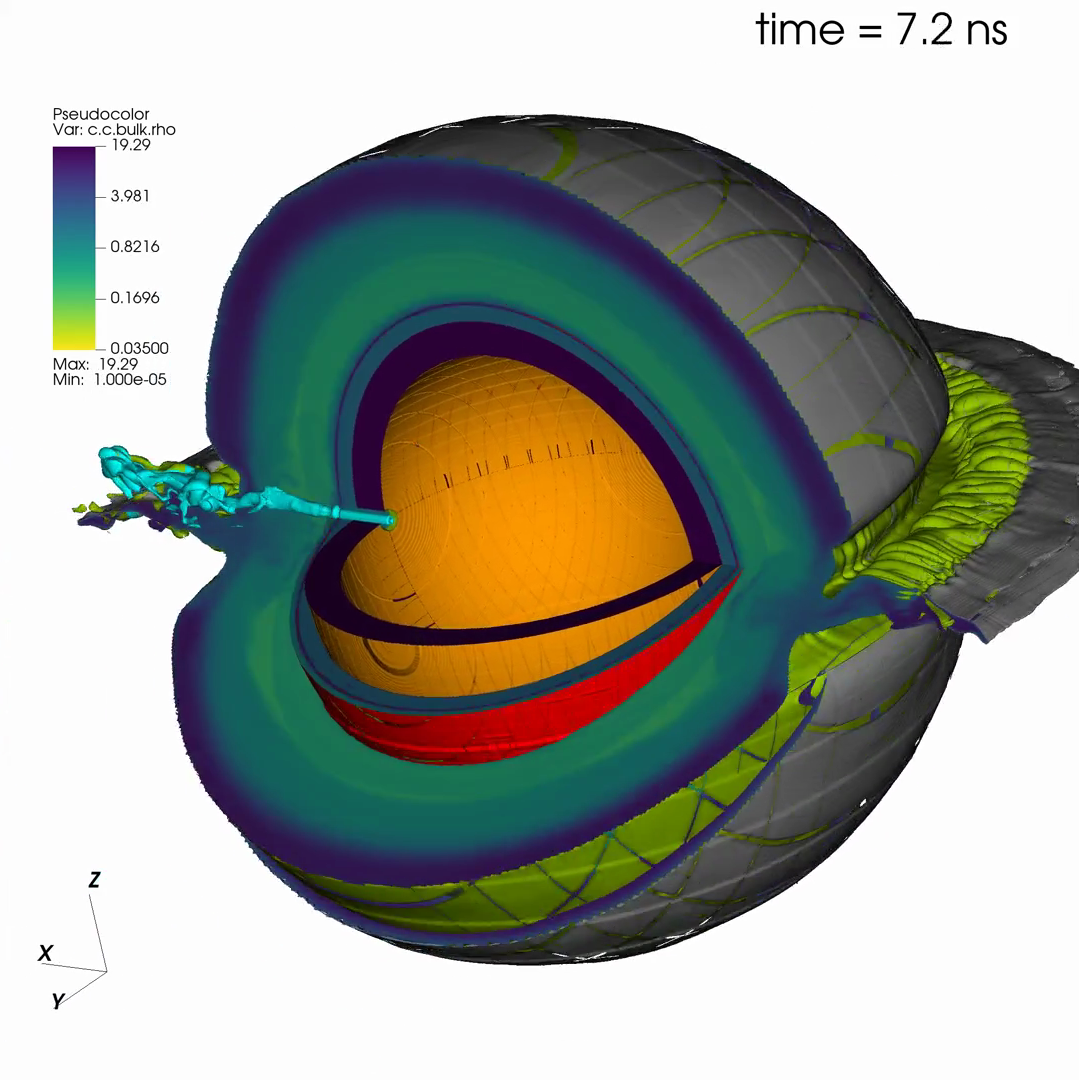
RIOT is a block adaptive mesh refinement (AMR) multi-material hydrodynamics code built atop the Parthenon performance-portability framework. Parthenon supplies the block-AMR infrastructure, load balancing, and communication machinery but contains no physics; RIOT supplies the hydrodynamics algorithm and the physics packages documented in this manual.
Organization of the Documentation
Each physics package in RIOT is documented in its own chapter. Every chapter follows the same structure:
the governing equations solved by the package, and
the user-tunable input parameters that control it.
Input parameters are organized into blocks. The recommended way to
write inputs is a Python script that calls riot.input(block, …)
for each block (Chapter The Python Interface); each call corresponds to
one block of the underlying text input deck (a .rin file). The
parameter tables in this manual list parameters by their block and
name (e.g. cfl in the <hydro> block); in a Python script these
are supplied as keyword arguments:
riot.input("hydro", recon="plm",   # reconstruction method
                    riemann="hllc",  # Riemann solver
                    cfl=0.8)         # CFL number
The same block in the equivalent text input deck reads:
<hydro>
recon   = plm      # reconstruction method
riemann = hllc     # Riemann solver
cfl     = 0.8      # CFL number
Each package chapter also includes a Registered Fields table listing the Parthenon fields that package creates, the symbol each maps to in the governing equations, its component count, and its metadata.
Note
For readability, the metadata column of every Registered Fields table lists the salient flags (e.g. Independent, Conserved, WithFluxes, Sparse, Derived) rather than the complete flag set passed in the source.
Running RIOT
After building RIOT, run the executable from build/src. Supply an input
deck with -i and, optionally, select an output directory with -d:
cd build/src
./riot -i input.rin -d /path/to/output/
mpiexec -n 4 ./riot -i input.rin -d /path/to/output/
The second command runs the same problem using four MPI ranks. See Building riot for prerequisites, configuration, and installation details.
Enabling Physics: the <physics> Block
Which packages are active in a run is controlled by boolean toggles in
the <physics> block. Hydrodynamics is on by default; the remaining
packages are off by default and are enabled here. Each package’s own
parameters live in its own block, documented in the corresponding
chapter.
Parameter |
Type |
Default |
Description |
|---|---|---|---|
hydro |
bool |
|
Enable hydrodynamics. |
strength |
bool |
|
Enable material strength. |
ionization |
bool |
|
Enable partial ionization. |
levelsets |
bool |
|
Enable level-set interface tracking. |
scalars |
bool |
|
Enable passive scalars. |
mix |
bool |
|
Enable the BHR RANS subgrid mixing model. |
tn |
bool |
|
Enable thermonuclear burn. |
radiation_transport |
bool |
|
Enable radiation transport. |
multigroup_diffusion |
bool |
|
Enable P1 radiation diffusion. |
gravity |
bool |
|
Enable a constant gravitational acceleration. |
prescribed_sources |
bool |
|
Enable prescribed energy sources. |
lasers |
bool |
|
Enable laser ray tracing and energy deposition. |
tracers |
bool |
|
Enable Lagrangian tracer particles. |
fixed_fluid |
bool |
|
Hold the fluid fixed (no hydro update). |
Sparsity
Many of RIOT’s per-material fields (cell-volume-averaged densities, volume fractions, and the derived material state of Chapter Materials and Equations of State) are registered as Parthenon sparse fields. A sparse field is allocated only on the mesh blocks where it is actually needed — for a material, only on blocks where that material is present — rather than everywhere in the domain. In a multi-material simulation where each material occupies a limited region, this saves substantial memory, since a block that contains none of a given material carries no storage for it. As materials move through the mesh, Parthenon allocates a material’s fields on blocks it enters and deallocates them on blocks it has left.
The deallocation step is controlled by sparse_dealloc in the
<materials> block. When true (the default), the fields of a
material that is no longer present on a block are freed, reclaiming
memory; when false, once-allocated fields persist for the rest of
the run.
Parameter |
Type |
Default |
Description |
|---|---|---|---|
sparse_dealloc |
bool |
|
Free a material’s fields on blocks it has left. |
Submodules
RIOT consumes several external libraries as submodules:
Parthenon — block-AMR framework (mesh, communication, load balancing).
singularity-eos — equation-of-state library.
singularity-opac — opacity library.
These are summarized briefly in their own chapter. It also relies on
Catch2 for unit tests and kokkos-kernels for device-side
linear solvers.
Contents:
- Building
riot - Materials and Equations of State
- Hydrodynamics
- Material Strength
- Ionization
- Laser Ray Tracing
- Level Sets
- Passive Scalars
- Gravity
- Prescribed Sources
- Tracer Particles
- Turbulent Mixing (BHR)
- Radiation Transport
- Radiation Diffusion (P1)
- Thermonuclear Burn
- Sparse Physics
- Regions
- The Python Interface
- Diagnostics
- Developer’s guide
- Contributing
Indices and tables
Acknowledgements
The first draft of this documentation was prepared with the assistance of Claude Opus, Anthropic’s large language model. The model was used to survey the RIOT source tree and its submodules, to draft the governing equations, parameter tables, and prose of the preceding chapters, and to produce the figures and example input decks. OpenAI ChatGPT via Codex was also used to assist in additional revisions.